
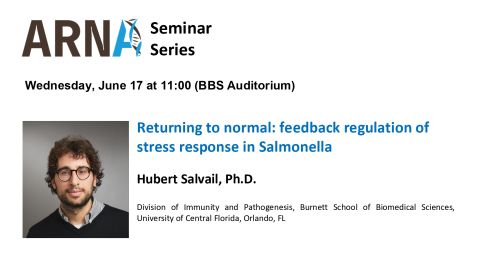
Hubert Salvail "Returning to normal: feedback regulation of stress response in Salmonella".
Abstract
Bacteria are exposed to various stress conditions in the niches they occupy. To survive to these stresses, they rely on various regulatory systems allowing them to reprogram their gene expression for exhibiting adaptive cellular behavior. While the gene expression programs deployed during stress response are critical for bacterial survival, they can interfere with normal cellular processes if their induction is sustained or not properly regulated. I will present three examples of feedback regulations that we predict to be crucial for fine-tuning stress response in the gastrointestinal pathogen Salmonella enterica serovar Typhimurium.
First, we established that the small RNA PinT mediates the negative feedback regulation of the PhoP virulence program by repressing the PhoP activator UgtL in acidic pH, an infection-relevant condition encountered by Salmonella inside macrophages. This regulation is conserved in Salmonella enterica, but not in the non-pathogenic species Salmonella bongori. As constitutive induction of PhoP is detrimental for virulence, the PinT-mediated repression of UgtL may be critical in fine-tuning PhoP activity for Salmonella to cause disease.
Second, we showed that the 3’UTR-derived small RNA RcsZ and its parental gene (ycfJ) mediate the negative feedback regulation of the Rcs envelope stress response and of the RpoS general stress response. The ycfJ-rcsZ gene is activated by RcsB in response to outer membrane perturbations and RcsZ inhibits the translation of rsd mRNA, encoding the anti-s70 factor Rsd that promotes RpoS access to the core RNA polymerase. As Rcs induction increases the levels of RpoS, which competes with s70 for accessing the RNA polymerase, we propose that the RcsZ-mediated repression of Rsd allows the return to normal housekeeping transcription after bacteria adapted to envelope stress. YcfJ impairs Rcs signaling and reduces Rsd levels, thus complementing RcsZ’s regulatory action of inhibiting Rsd.
Third, we found that the abundance of the RNA chaperone Hfq is regulated by the Hfq-dependent small RNA CpxQ during envelope stress. We predict that CpxQ base pairs with hfq mRNA to repress its translation. This regulation may allow CpxQ to feedback regulate its own activity during envelope stress and Salmonella to maintain homeostatic levels of Hfq.
Contact
- Fabien Darfeuille, fabien.darfeuille@u-bordeaux.fr
Flyer Séminaire Hubert Salvail
Dernière mise à jour :