
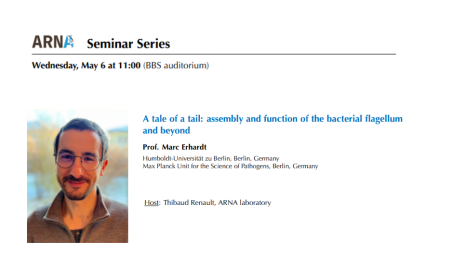
Marc Erhardt présentera une conférence intitulée "A tale of a tail: assembly and function of the bacterial flagellum and beyond".
Abstract
Life has evolved diverse protein machines and bacteria provide many fascinating examples. Despite being unicellular organisms of relatively small size, bacteria produce sophisticated nanomachines with a high degree of self-organization. The motility organelle of bacteria, the flagellum, is a prime example of complex bacterial nanomachines. Flagella are by far the most prominent extracellular structures known in bacteria and made through self-assembly of several dozen different kinds of proteins and thus represents an ideal model system to study sub-cellular compartmentalization and self-organization.
Beyond motility, bacterial flagellar components are also co-opted in defense against bacteriophages. The recently identified Zorya anti-phage defense system, composed of membrane and cytoplasmic proteins homologous to flagellar stator components, demonstrates how bacterial nanomachines can be repurposed in response to phage threats.
In my talk, I will discuss our results on the dynamic self-assembly of bacterial flagella and how structure-based mutagenesis, functional assays, and live-cell fluorescence microscopy have enabled us to characterize the activation and phage-sensing mechanisms of the Zorya system.
Contact
- Thibaud Renault, thibaud.renault@u-bordeaux.fr
Flyer Séminaire Pr. Marc Erhardt
Dernière mise à jour :